
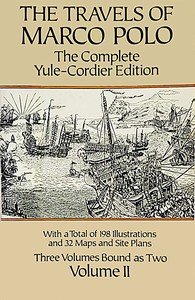
The Travels of Marco Polo — Volume 2 by Marco Polo and da Pisa Rusticiano
Let's set the scene: It's 1298, and Marco Polo is a prisoner of war in Genoa. To pass the time, he dictates his life story to his fellow prisoner, Rustichello da Pisa, a writer of romances. What comes out isn't a dry history book, but a wild, firsthand account of Polo's journey across Asia to the court of Kublai Khan, grandson of Genghis Khan. Volume 2 picks up with Polo in the service of the Khan himself. This isn't a tourist's vacation slideshow; it's the report of a trusted envoy.
The Story
The book doesn't have a plot in the modern novel sense. Instead, it's a sprawling journey through the Mongol Empire. Polo describes the incredible cities of Cathay (China), the mind-boggling wealth and sophistication of Khan's court, and the strange customs of countless peoples. He talks about paper money, coal, a postal system that spanned continents, and cities so large they take days to cross. He serves as the Khan's eyes and ears, traveling on missions to far-flung provinces like Burma and Tibet, reporting back on everything from local rebellions to the best hunting grounds. The central thread is Polo's relationship with the all-powerful Khan, a man of immense curiosity who values this foreigner's perspective.
Why You Should Read It
What grabbed me wasn't just the 'wow' factor of the descriptions—though the tales of palaces and festivals are amazing. It's the voice. You can feel Polo's genuine awe and sometimes his confusion. He's trying to explain a rhinoceros (which he calls a unicorn) or the concept of Buddhism to a medieval European audience that has no frame of reference. The book is a raw record of cultural collision. You're seeing the East through the only lens a 13th-century Venetian merchant had: comparing everything to back home. Is he exaggerating? Probably in places. But that's part of the fun. You're reading the book that literally shaped Europe's view of Asia for centuries, inspiring everyone from merchants to Columbus.
Final Verdict
This is for the curious traveler, the armchair historian, and anyone who loves a good story that happens to be true (mostly!). It's not a fast-paced novel; it's a book to savor in chunks, to get lost in the details of a lost world. If you enjoy primary sources that let you hear a voice from the distant past, speaking plainly about extraordinary things, you'll be captivated. Perfect for history buffs who want to go beyond dates and battles, and for anyone who needs a reminder of how vast and wonderfully strange our world has always been.
Legal analysis indicates this work is in the public domain. Use this text in your own projects freely.
Christopher Wright
5 months agoVery helpful, thanks.
Mary Scott
1 year agoCitation worthy content.
Ava Allen
4 months agoSimply put, the arguments are well-supported by credible references. Exactly what I needed.
Margaret Jackson
5 months agoBased on the summary, I decided to read it and the narrative structure is incredibly compelling. Thanks for sharing this review.


Edward Hill
1 year agoI started reading out of curiosity and the atmosphere created is totally immersive. I learned so much from this.