
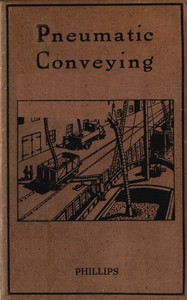
Pneumatic conveying by Ernest George Phillips
Let's be clear from the start: Pneumatic Conveying is not a novel. You won't find a dashing hero or a twisting plot. Instead, Ernest George Phillips has written what amounts to a very enthusiastic and detailed guidebook. Published in the early 20th century, it captures a specific moment in industrial history when using air pressure to move bulk materials went from a curious novelty to a serious engineering practice.
The Story
There's no traditional story, but there is a clear narrative of problem-solving. Phillips lays out the basic challenge: moving powders, grains, and other dry materials is messy, slow, and labor-intensive. Then, he introduces the elegant solution—pneumatic systems. The 'plot' follows the logic of the machines themselves. He explains the two main characters: pressure systems (which push material) and vacuum systems (which suck it). He walks through the components—pipes, separators, airlocks, and fans—like introducing the cast. The drama comes from the practical hurdles: how to prevent blockages, how to calculate the power needed, and how to design a system that doesn't grind the material to dust. It's a step-by-step reveal of how to make an invisible force do tangible work.
Why You Should Read It
I picked this up on a whim, and I'm glad I did. Its charm is in its straightforward passion. Phillips isn't writing for poets; he's writing for engineers and factory managers who need to get things done. That clarity is refreshing. You get a real sense of the 'how' and the 'why' behind a technology we still rely on. Reading it feels like looking over the shoulder of a practical inventor. You see the gears turning as he weighs different solutions. It's also a fascinating historical artifact. It shows us what cutting-edge industrial technology looked like over a century ago, reminding us that the 'smart' systems of today are built on foundational ideas like these. It turns something mundane—moving grain—into a puzzle of physics and ingenuity.
Final Verdict
This book is a niche gem. It's perfect for history of technology buffs, curious engineers, or anyone who loves 'How It's Made' documentaries. If you enjoy understanding the hidden systems that make our world function, you'll find this surprisingly engaging. It's not for someone looking for a relaxing bedtime story, but for the right reader, it's a direct line to the pragmatic, problem-solving mind of a past era. Think of it as a primary source on the birth of modern industrial logistics, written with quiet confidence by someone who truly understood his subject.
This content is free to share and distribute. You do not need permission to reproduce this work.
Jackson Allen
1 year agoSimply put, the clarity of the writing makes this accessible. I would gladly recommend this title.
Ava Anderson
1 year agoGood quality content.
Patricia Robinson
6 months agoI had low expectations initially, however the storytelling feels authentic and emotionally grounded. A valuable addition to my collection.
George Anderson
2 years agoNot bad at all.







Brian King
9 months agoMy professor recommended this, and I see why.