
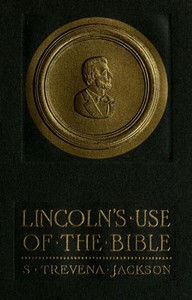
Lincoln's Use of the Bible by S. Trevena Jackson
Forget everything you think you know about dusty old academic books. Lincoln's Use of the Bible by S. Trevena Jackson is a surprisingly lively investigation. Published in the early 1900s, it feels less like a lecture and more like following a researcher on a hunt. Jackson isn't just listing Bible quotes Lincoln used; she's trying to understand why he used them and how they worked.
The Story
The book doesn't have a plot in the novel sense. Its 'story' is the journey of Lincoln's relationship with the Bible. Jackson starts by acknowledging Lincoln wasn't a churchgoer or a theologian. Then, she systematically shows how, as President, he turned to biblical stories, phrases, and rhythms to communicate with a nation steeped in that language. She walks us through his major speeches and writings, pointing out the references—some obvious, some hidden. We see how he used the story of the 'house divided' to argue against slavery's expansion, and how psalms and prophets shaped his understanding of the Civil War's suffering and the need for reconciliation. The 'conflict' is between Lincoln's personal beliefs and his public, masterful use of religious language as a political and moral tool.
Why You Should Read It
This book made me listen to Lincoln's words differently. It’s not about proving he was a secret Christian; it's about showing his genius as a communicator. Jackson reveals how he spoke in a code everyone understood, using the Bible's authority to frame national crises in terms of right, wrong, and divine justice. You get a real sense of his strategic mind. He chose references that would resonate with Northern abolitionists and appeal to the conscience of everyday people in the border states. It adds a brilliant layer to his legacy. He wasn't just a great writer; he was a translator, taking the nation's deepest moral text and using it to hold the country together.
Final Verdict
Perfect for history lovers, word nerds, or anyone who enjoys a good intellectual puzzle. If you like podcasts that dissect famous speeches or articles about the power of language, you'll love this. It's a slim volume, so it's not a huge commitment, but the ideas stick with you. Just be ready for its early 1900s writing style—it's clear, but has its own rhythm. This is a hidden gem for seeing a familiar giant of history in a completely new light.
There are no legal restrictions on this material. Knowledge should be free and accessible.
Carol Thompson
2 years agoHaving read this twice, the character development leaves a lasting impact. Highly recommended.
Kenneth Torres
9 months agoMy professor recommended this, and I see why.




Liam Flores
1 year agoEnjoyed every page.