
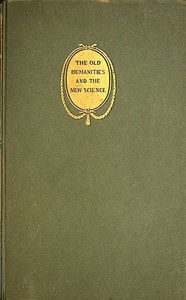
The Old Humanities and the New Science by Sir William Osler
This isn't a novel with a plot, but it has a powerful central idea. In The Old Humanities and the New Science, Sir William Osler, a legendary physician, gives a speech. He looks at the early 20th century, a time of exploding discovery in physics, biology, and medicine. But he sees a problem: this exciting new world of science is growing apart from the traditional study of the humanities—things like literature, philosophy, and ancient history. He worries that in our rush to understand the how of things, we're forgetting to ask why. The book is his argument for why we need both sides of that coin to be truly educated and humane people.
Why You Should Read It
What grabbed me was Osler's voice. He's not some stuffy academic scolding us. You can feel his genuine love for both Shakespeare and a microscope slide. He quotes poets as easily as he discusses medical breakthroughs. His point is that science gives us power, but the humanities give us wisdom and compassion to use that power well. Reading this in the 21st century, with debates about AI and technology everywhere, makes his words feel prophetic. He was writing just after World War I, a conflict where technology caused horrific suffering, and his message feels urgent: technical knowledge without moral guidance is a dangerous path.
Final Verdict
This is a perfect short read for anyone curious about the never-ending 'arts vs. sciences' debate. It's for the student choosing a major, the engineer who loves a museum, or the book club looking for a non-fiction discussion starter. It's also a treat for history fans who want to step into the mind of a great thinker at a pivotal moment. Don't expect a simple answer—Osler offers a thoughtful, hopeful vision for a balanced life of the mind. If you want a quick, insightful dose of perspective on our modern world, this century-old book delivers.
This masterpiece is free from copyright limitations. It serves as a testament to our shared literary heritage.

Steven Martinez
5 months agoWithout a doubt, it challenges the reader's perspective in an intellectual way. I couldn't put it down.